From the Weaver Street Market Board of Directors
Fellow Owners of Weaver Street Market,
We are grateful for the honest feedback we received from 2,353 of you in response to our owner’s survey last September. We, the Weaver Street Market (WSM) Board, thank you.
This letter is to inform you of the survey results and how those results will be used.
We first affirm our commitment to transparency. We will present the results of the survey. We will describe the Board’s role in the governance of WSM, as that role guides our interpretation of all results. Then we’ll define our approach to the interpretation of the data, and share how we interpreted it.
Lastly, we will speak to the Board’s commitment to improved communication with owners and possible ways to invite broader participation in our cooperative’s mission.
2017 Owner Survey Overview
As you will see from the general survey results, our Net Promoter Score is 77. We calculated this score based on the responses to the first question of the survey: “How likely is it, on a scale of 1 to 10, that you would recommend Weaver Street Market to a friend or colleague?”
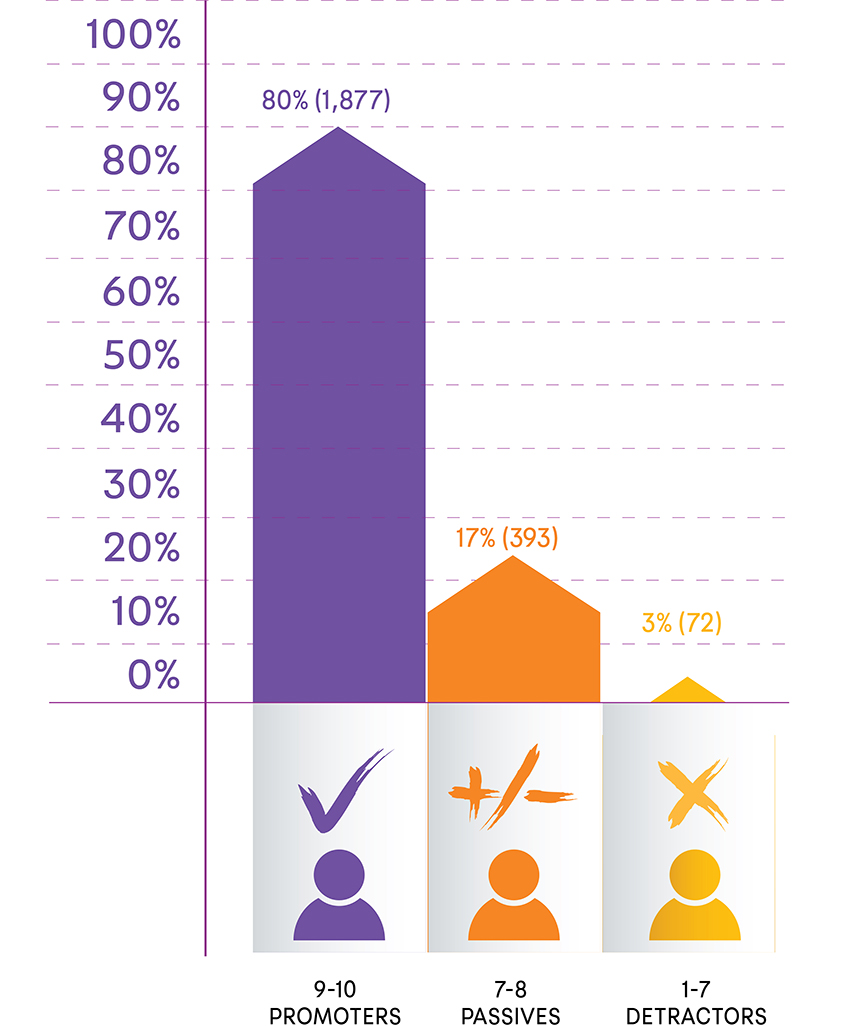
Using the Net Promoter framework as a basis for comparison, we classified any score of 9 or 10 as a promoter, and any score of 6 or lower as a detractor. The net promoter score is simply the percentage of promoters less the percentage of detractors (in our case 80% – 3%). We are pleased to say that our score of 77 is higher than all reported results from other grocery stores.
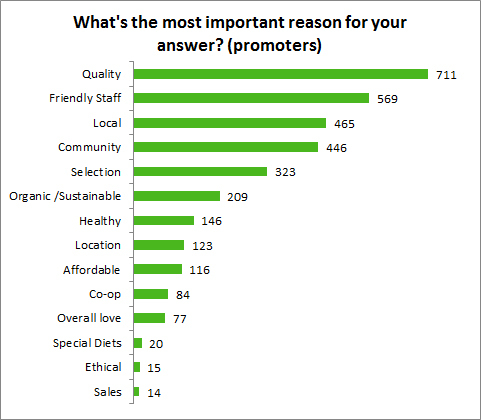
The factors most frequently cited by our promoters include food quality, local sourcing, community involvement, and our market as a friendly, welcoming gathering place. Our promoters also value healthy, fresh, and organic foods—especially in our produce department. Many promoters appreciate our baked goods, our meat and seafood, and our beer and wine selections.
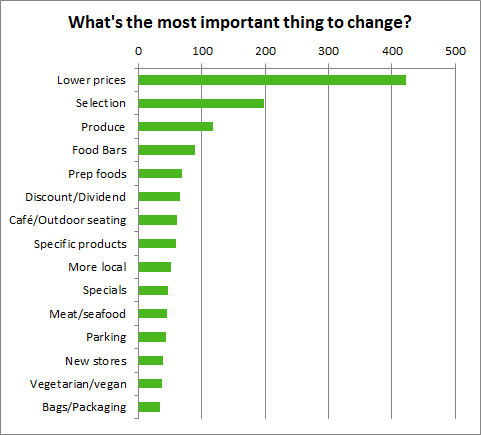
We hear your criticisms, too. There is always room for growth and improvement. In the survey’s second question, the most frequently cited changes owners would like to see are lower prices and wider selection.
Board’s Role in Governance and in Interpreting the Survey Results
What do we do with the whole range of responses?
Generally speaking, the Board’s role is to be accountable to the owners of Weaver Street Market. As the representative of all owners, the Board articulates an Ends (Mission) Statement, and uses it as a benchmark to measure all our results.
This is Weaver Street Market’s Ends Statement:
A vibrant, sustainable food marketplace, defined by shared economics, shared community, and shared knowledge; driven by widespread and diverse participation; for the owners and potential owners.
The Board is accountable for seeing that WSM Ends are fulfilled and that such fulfillment avoids unacceptable activities, conditions, and decisions. In other words, the Board ensures that (a) articulated results in the Ends are accomplished and (b) those results are produced ethically and prudently.
At all times the Board must be confident and convinced that there’s a plan and the necessary data to address not only the most pressing needs but also the mission of WSM now and long into the future.
Thus, in terms of the survey, the Board determines whether the results are in line with our Ends, and whether the results warrant a change in policies that, in turn, will influence and impact operational planning, decisions, and actions.
While we can say that owners generally hold many common values, individual concerns do arise. Addressing specific concerns involves balancing numerous factors, including what we are able to do and capable of doing amid competing priorities and resources.
Take, for example, parking. For some owners, especially those who frequent the Carrboro store, readily available, conveniently located parking is clearly an issue.
To deal with parking is to confront that WSM is intentionally located where parking may be limited. Fundamentally, WSM revitalizes downtowns, creating vital gathering places for local communities. This is so in Carrboro, Hillsborough, and Southern Village, and with our upcoming new location in downtown Raleigh. Downtown locations, where parking may be limited, and providing gathering places are priorities over having large, store-front parking in strip mall settings. This presents a trade-off. We could encourage Carr Mill Mall to do more towing; however, in the past this has created ill will among our owners and seemed to do more harm than good.
Once we have situated an issue in relation to our broader mission and management’s annual plan, we consider the threshold at which we need to resolve or at least to ameliorate the issue. Factors such as cost, prior contracts, and compliance with state and local laws all go into defining a threshold. With the parking in our new store in Raleigh, for example, we worked for many months with both the developers of the site and officials from the City of Raleigh to create a system of vouchers for WSM patrons to use at a nearby parking garage.
Board Interpretation of the Survey Results
With this approach in mind, we return to the owner survey. The Board separated the results into two categories: points of difference and points of parity with other grocery stores.
Our points of difference are the things that make WSM unique: for example, our work with local farmers to increase their production, our campaigns on behalf of food insecurity groups, and our emphasis on healthy and good tasting food. The Board considers the results of the survey an affirmation of these points of difference, and very much what we want to continue to expand and improve.
Our points of parity are the things that other grocery stores offer on par with WSM, or better. Primarily these involve price and selection.
Of course, we want to offer the highest-quality food at the lowest possible price. But many factors affect price. Perhaps the most significant is our relatively small size; Walmart, for example, can command a lower cost of goods because it buys in huge quantities. We’ve taken many actions to reduce costs: adopting the organic Field Day brand that is available to co-ops, sourcing directly from co-op partners like Cabot and Riojana, and renting warehouse space to store nonperishable goods that we buy in large quantities. Our merchandising team actively looks for deals. We continue to offer our bulk section where customers can buy at lower prices (and with reduced packaging!). In some cases, as with our local organic breads, our prices are actually better than those of most competitors.
Perhaps the clearest sign of our intent to make healthy food affordable is the continual reduction of our gross margin (the difference between the price we pay and the price at which we sell an item), which is lower than the national standard for food cooperatives. Annually, WSM makes a net profit of only about 1 percent. Typically, we reinvest that small profit into things like equipment upgrades, individual store renovations, loans to local producers, and low-cost health care benefits for our workers.
We approach selection as skilled and knowledgeable curators in the industry, and we regularly review all the items in our stores. Selection is governed not only by cost and floor space but by our aim to foster trust. Ideally, we want any patron to take any item off the shelf, and trust that it will be a quality product that aligns with our community values, including an increase of our local and coop-to-coop trade. This places a welcome constraint on our selection. For so many reasons we will never sell Coca-Cola in our stores—and that includes price.
Future Feedback Opportunities
The survey highlighted other issues of concern, like the distribution of dividends and our café seating. The Board recognizes these issues and will elaborate on them in further communications.
We are working to create a more responsive feedback loop, and a more transparent way to explain our strategic decisions. We are considering several ideas, including a permanent online FAQ, expanded over time to address point by point owners’ questions and concerns. The Board is also looking to create introductory sessions for co-op members, especially for new members; follow-up surveys; and possibly a platform for deeper discussion of issues—new ways, in short, to bring more owners into the conversation. Owners are always welcome to attend a Board meeting or to email the Board at board@weaverstreetmarket.coop.
Lastly, the Board notes that WSM’s identity as a cooperative—a market for the community, by the community—scored relatively low with promoters as an important reason to recommend us. We will work to engage more and more owners in seeing the cooperative model as a true service to any community.